
 English
  Español
  Deutsch
  Français
  Português
  Italiano
  Nederlands
  Polski
  Svenska
DLSS 5 stops being a trade-show demo this week. NVIDIA switches it on 3 September at 9:00 PM Pacific in NBA 2K27, across the whole GeForce RTX 50 series, desktop and laptop alike, plus GeForce NOW Ultimate subscribers streaming from RTX 5080-class rigs. It is the first public implementation of what the company calls 3D-guided neural rendering, and it is worth understanding properly, because it does not resemble anything DLSS has done so far.
The fundamental difference: this adds, it doesn’t reconstruct
Everything DLSS has done since 2018 comes down to reconstructing information that was already there. Super Resolution rebuilds a higher-resolution image from a lower one. Frame Generation and Multi Frame Generation interpolate intermediate frames. Ray Reconstruction replaces the traditional denoiser to clean up ray-traced lighting. NVIDIA puts the combined output of the DLSS 4.5 stack at 23 out of every 24 pixels drawn by AI.
DLSS 5 does something else. It takes the frame the engine has already rendered and adds lighting and material detail that was never computed, because the millisecond and VRAM budget did not stretch to modelling it. Subsurface scattering in skin, light transmitted through hair and foliage, tighter contact shadows, better-defined ambient occlusion. The sort of thing a VFX shot resolves with hours of compute per frame and a game cuts as a matter of course: individual strands swapped for simplified geometry, multi-layer materials like skin flattened until they lose their depth.

The company places the move on its own historical line: programmable shaders with the GeForce 3 in 2001, CUDA with the 8800 GTX in 2006, real-time ray tracing with the RTX 2080 Ti in 2018, and path tracing with neural shaders on the RTX 5090 in 2025. Along the way, 375,000 times more compute — and the gap to a film frame still refuses to close by brute force.
Why you can’t just bolt on a generative model
Here is the interesting part from an engineering standpoint. A conventional diffusion model will produce ten different results if you hand it the same prompt ten times. For a still image that hardly matters, because a human is picking. In a game it is unacceptable: a character’s face cannot change between milliseconds, and the player expects the same scene to look the same every time they turn to face it.
NVIDIA describes three problems it had to solve before a generative model could sit in the render path.
Determinism. The model is anchored to the rendered frame. It does not start from a text description; it starts from the colour and motion vectors the engine hands over, and it has been trained to read engine data directly: surface albedo, detailed lighting, normals. Artist-authored geometry rules; the model only decides how light responds to it. Same input, same output.
Temporal stability. Unlike video models, which work over batched sequences, DLSS 5 runs on a strict one-frame-in, one-frame-out scheme. It uses the engine’s motion vectors so you don’t get shimmer, texture swimming or temporal drift when the player moves. Anyone who has lived with a badly tuned temporal reconstructor knows exactly which artefacts we’re talking about.
Speed. The third problem was fitting it into the frame budget. The answer is a compact, specialised network that reads engine data straight off the rendered frame and leans on the RTX 50 series Tensor Cores. It runs locally, on a single GPU, at resolutions up to 4K.

The detail that decides whether this is useful: the artist controls
A technology that automatically prettifies things is a technology that treads on art direction. NVIDIA seems well aware of it, because half the announcement is about controls rather than image quality.
The SDK ships several models with different weights, and the studio picks. Nor is it a single decision for the whole game: they can be mixed, one model for exteriors with dense vegetation and another for dramatically lit interiors, or one for gameplay and a different one for cutscenes.
On top of that sit two intensity controls. Structure Intensity governs high-frequency detail: ambient occlusion, reflections, subsurface scattering. Tone Intensity governs the low-frequency end, the broader light and colour response; set to zero, it respects the rendered frame’s colours exactly.
Then there are two masking layers. A semantic one, where the model itself recognises objects in the scene and lets you push enhancement on the environment while holding back on characters, or the other way round. And an engine-level one, to isolate specific props — glassware, water droplets, foliage — and tune them without touching what surrounds them. For the player, by contrast, it is a switch: on or off.
Output quality depends on input quality
This is the technical caveat that will shape results in practice more than any other, and NVIDIA states it plainly: the neural output stays anchored to the base frame, so final quality scales with the fidelity of what goes in. DLSS 5 noticeably improves a traditional rasterised render, but feeding it ray-traced or path-traced lighting produces markedly more accurate results.
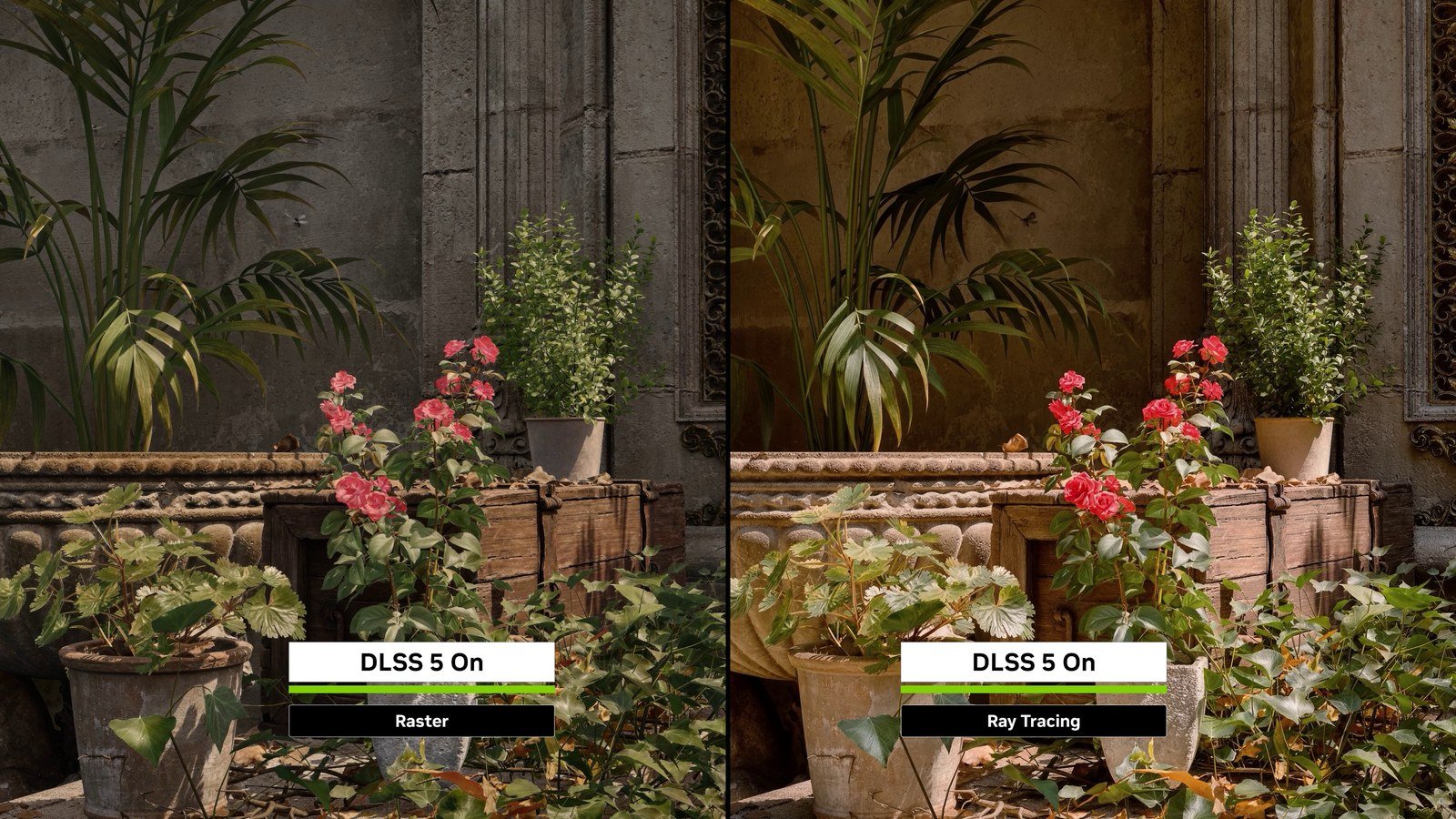
Translated: anyone expecting this to rescue a game with poor lighting is going to get less than they imagine. It pays off most precisely where there was already a good render underneath.
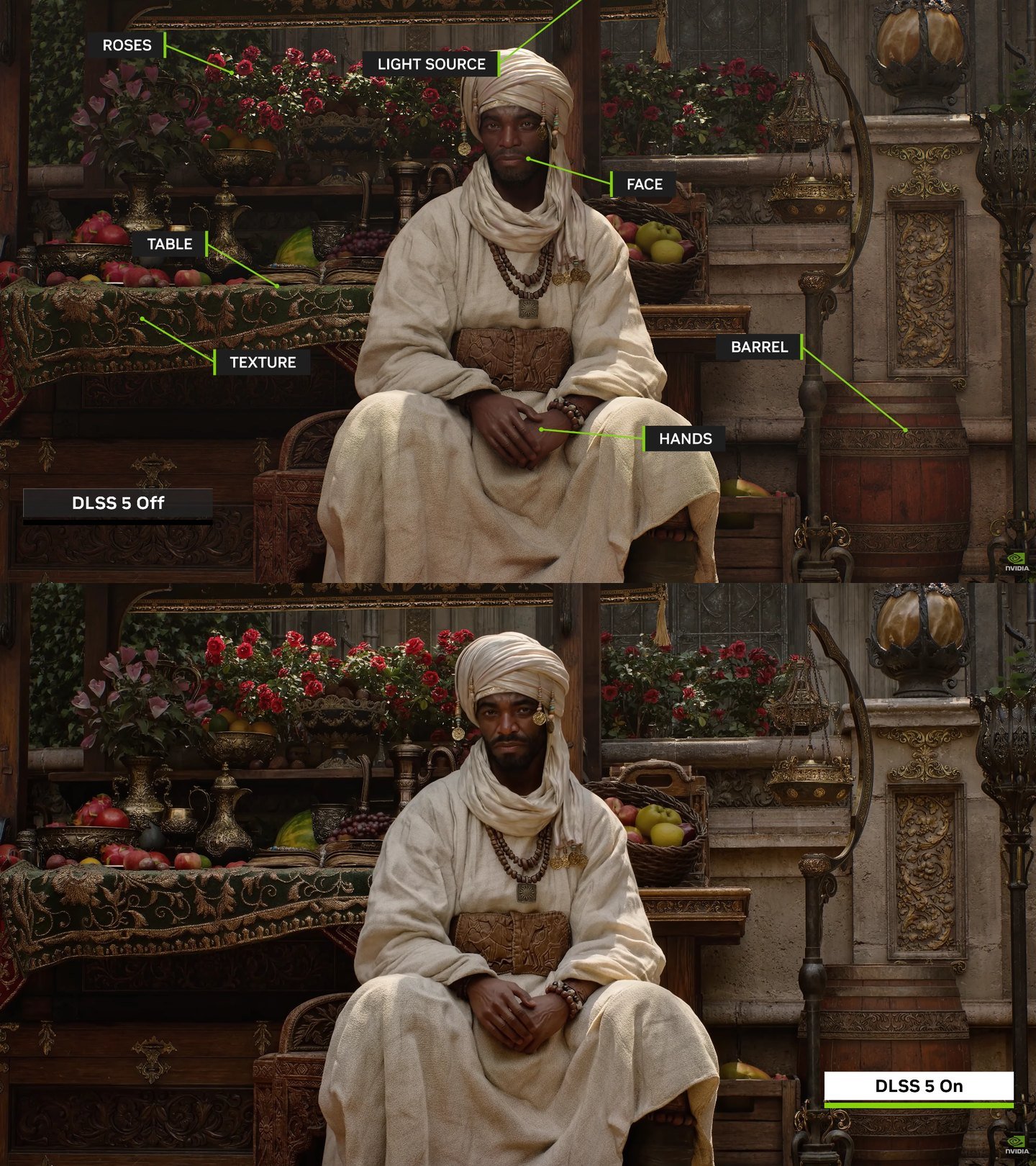
From two RTX 5090s to a single card in six months
The most revealing engineering figure in the announcement is the trajectory. When DLSS 5 was first shown, back in March, it ran split across two GeForce RTX 5090s. Today it runs on one card, and it reaches the entire RTX 50 range, laptop GPUs included. NVIDIA puts that gain at five times the performance in six months, the result of systematic pipeline optimisation and refinements to the neural model itself.
The company adds that the optimisation curve is not flattening out, that more work is under way, and that it expects model updates through the autumn that push past today’s launch performance.
Which numbers NVIDIA publishes, and which it doesn’t
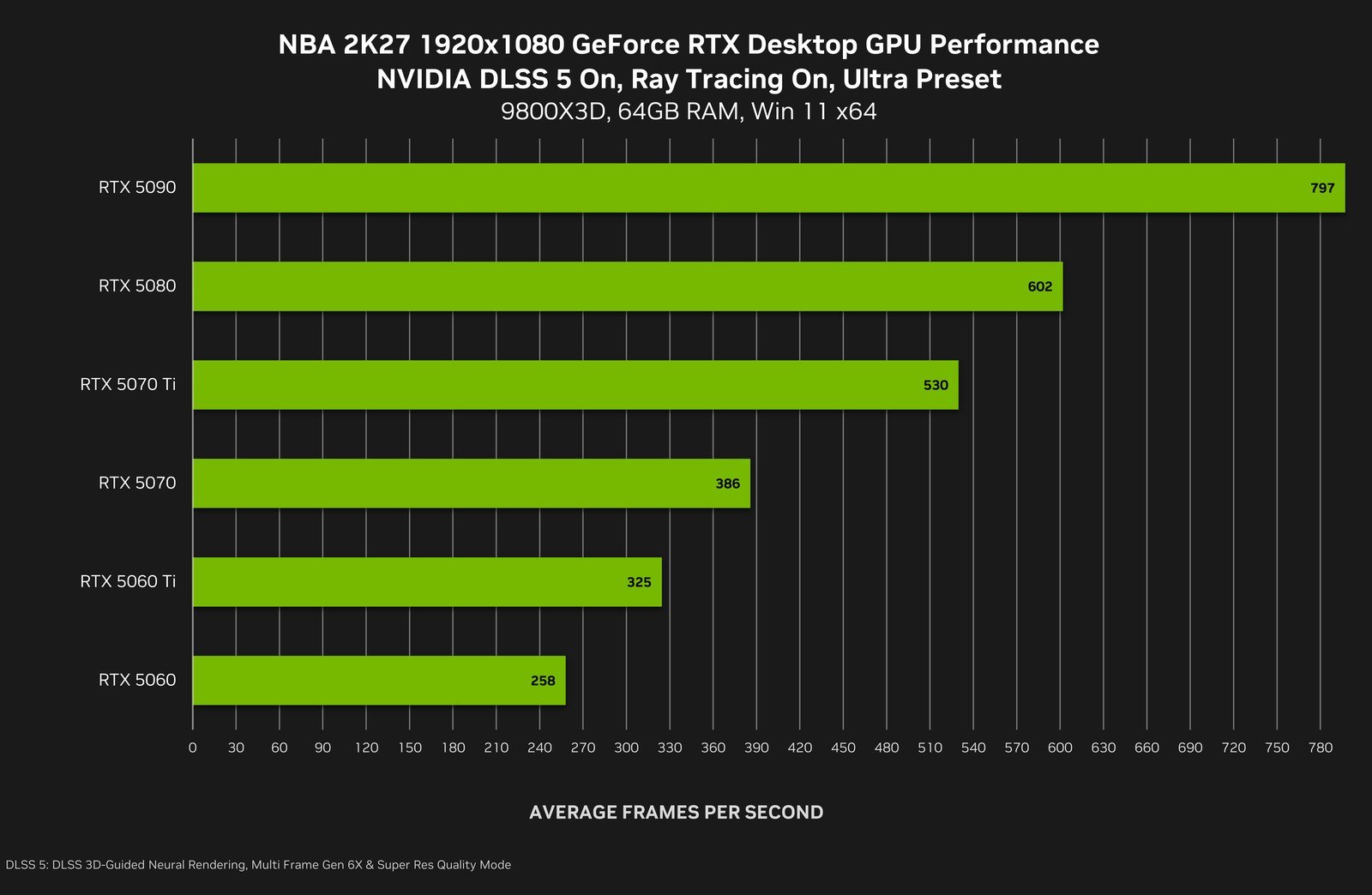
The numbers need reading carefully, because the conditions sit in the footnotes of the company’s own charts and change their meaning considerably. Every measurement is NBA 2K27 on the Ultra preset with ray tracing, on a rig with a Ryzen 7 9800X3D, 64 GB of memory and Windows 11, and with the full DLSS stack: neural rendering, Super Resolution and Multi Frame Generation in 6X mode. At 4K, Super Resolution is additionally set to Performance; at 1440p and 1080p, to Quality.
- 3840 × 2160: 370 FPS on the RTX 5090 and 233 on the RTX 5080.
- 2560 × 1440: 594 FPS on the RTX 5090, 413 on the RTX 5080, 353 on the RTX 5070 Ti and 262 on the RTX 5070.
- 1920 × 1080: 797 FPS on the RTX 5090, 602 on the RTX 5080, 530 on the RTX 5070 Ti, 386 on the RTX 5070, 325 on the RTX 5060 Ti and 258 on the RTX 5060.
What is absent from the company’s documentation is the figure a technical analysis would ask for first: what neural rendering costs like for like — the same game and the same settings with the switch on and off. That comparison has not been published. The fact that NVIDIA itself presents the past six months’ performance work as a fivefold win, and promises more optimisation for the autumn, tells you on its own that running the model is not cheap.
How many frames are actually rendered
The footnote on NVIDIA’s charts makes clear that frame multiplication is set to 6X mode: of every six frames reaching the monitor, one is rendered and five are generated by AI. Dividing the published figures by that factor gives the real rate at which the card is drawing the scene, which is what governs controller response and latency.
At 4K with Super Resolution on Performance, the RTX 5090’s 370 FPS come out of roughly 62 rendered frames per second, and the RTX 5080’s 233 out of about 39. At 1080p on Quality, the scale runs from 133 on the RTX 5090 down to 43 on the RTX 5060, by way of 100 on the RTX 5080, 88 on the RTX 5070 Ti, 64 on the RTX 5070 and 54 on the RTX 5060 Ti.
Those are perfectly playable figures, and in a basketball game with the latency the simulation itself imposes they pose no problem at all. But they explain why the charts show three-digit numbers: most of those frames were not drawn by the rasteriser.
Opinion: the missing number says plenty
There is a reasonable reading of the cost without measuring anything, and it comes from the data NVIDIA itself has put on the table.
In March, this needed two RTX 5090s. Two. The most powerful card in the consumer catalogue, doubled up, to run a model applied on top of an already rendered frame. A fivefold gain in six months is remarkable optimisation work and deserves to be recognised as such, but it also fixes the starting point: the cost was so high that no home configuration could absorb it. That it now fits on a single GPU does not mean it is free; it means it has gone from impossible to viable.
The second clue is how the figures are presented. The RTX 5090’s 370 FPS at 4K are not DLSS 5’s performance; they are the performance of DLSS 5 plus Super Resolution plus Multi Frame Generation. In other words, a number reached by rendering internally at lower resolution and multiplying frames, with neural rendering subtracting underneath. Presenting the aggregate figure is legitimate as a product argument, but it does not answer the technical question, and the fact that the direct comparison with the switch off appears nowhere invites the thought that it is not the most flattering chart.
The third is the commitment to keep optimising through the autumn. Nobody promises performance gains on something that already has headroom to spare.
And there is a fourth factor worth holding on to before extrapolating: NBA 2K27 takes place in an enclosed arena, with a bounded number of characters and modest scene geometry compared with an open world. It is a comfortable setting in which to launch a technology applied across the full frame. The numbers from a basketball game do not carry over to a forest with dense vegetation, or a city with dozens of dynamic light sources — which is exactly where neural enhancement has most to contribute and where it will cost most.
The cold conclusion: DLSS 5 is not a performance technology, it is a fidelity technology paid for in performance, which is why it arrives propped up by the rest of the DLSS stack, the part that replaces what this one consumes. That does not invalidate it in the slightest — anyone playing at 1440p on an RTX 5080 with frames to spare has an excellent use for them here — but it changes how you frame it. It is the opposite of what DLSS has meant for seven years, and it is worth saying so that plainly.
NBA 2K27, and why that game in particular
The choice of launch title is no accident. Visual Concepts has spent more than twenty-five years chasing a version of NBA 2K that looks like a television broadcast, and that goal is won or lost almost entirely on skin, hair and fabric under arena lighting: precisely the ground where subsurface scattering and contact shadows make the difference.

NVIDIA describes the effect on specific players: on Cade Cunningham, skin with believable warmth under the court lighting, tighter contact shadows at the neck and jersey collar, and better hair definition through light transmission. On Tyrese Haliburton, precise shadows under the nose and chin, and more pronounced ambient occlusion in the folds of the compression sleeve. The crowd and bench staff get the same treatment.

The part that genuinely matters for a game built on scanned faces of real athletes is that the facial geometry is left alone. Peter Kavic, senior producer at Visual Concepts, describes the per-pixel enhancement mask control as the tool that lets them dial in detail on characters while preserving their likeness.
How to turn it on
Inside the game, under Video Settings, there is an option called DLSS Neural Rendering that needs setting to On. The rest of the stack — Super Resolution, Frame Generation and NVIDIA Reflex — is configured separately, to taste. During play and in replays, F9 toggles neural rendering, which lets you compare on the fly rather than trusting screenshots.
What remains to be seen
Integration comes through two routes, the NVIDIA Streamline framework and an Unreal Engine 5 plugin, which lowers the barrier to adoption considerably. And DLSS 5 replaces nothing: it sits as the final stage of the render path, above rasterisation, ray tracing and path tracing, and on top of the rest of the DLSS family.
From here, two questions stay open. First, how long this takes to reach games that aren’t a technical showcase prepared hand in hand with the manufacturer, and above all genres with far more expensive scenes to render. Second, the more uncomfortable one for anyone on an RTX 40 or older: the model leans on the 50 series Tensor Cores, and the company has proposed nothing for earlier hardware.
On 3 September, with the switch and the F9 key within everyone’s reach, the first of the two starts answering itself.