
 English
  Español
  Deutsch
  Français
  Português
  Italiano
  Nederlands
  Polski
  Svenska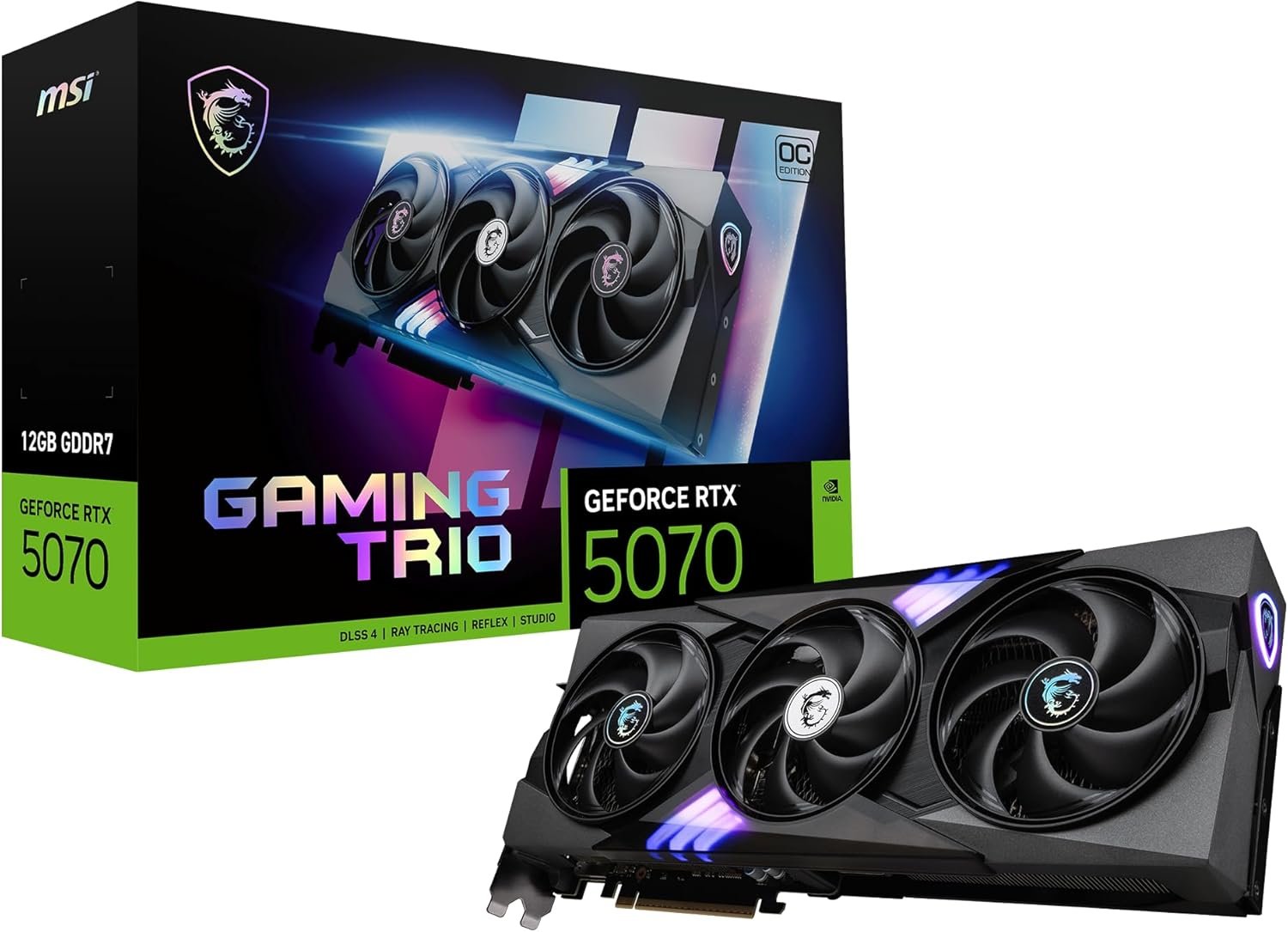
MSI’s Gaming Trio OC is the company’s premium air-cooled interpretation of the GeForce RTX 5070, and its target is unusually clear: the 1440p player who wants Blackwell’s full feature set — DLSS 4, the fourth-generation ray tracing cores, the new GDDR7 memory — without paying the entry fee of a 5070 Ti or an RTX 5080. The silicon underneath is the same 6,144-core GB205 die that every other RTX 5070 uses, so what MSI is really charging a premium for is the cooler, the factory overclock and the engineering wrapped around them.
Blackwell on a 192-bit bus: what the numbers actually mean
The headline figure is the memory. Twelve gigabytes of GDDR7 running at 28 Gbps is a genuine generational jump over the GDDR6 that the previous mid-range relied on, and it goes a long way towards offsetting a 192-bit bus that looks narrow on a spec sheet. Bandwidth, not capacity, was the bottleneck that used to strangle cards in this class, and Blackwell largely solves it. The Gaming Trio OC ships with a 2,610 MHz boost clock out of the box and steps up to 2,625 MHz in the Extreme Performance profile through MSI Center — a modest bump that lands within the margin most factory-overclocked cards occupy, and one that is worth roughly a couple of frames rather than a tier of performance.
1440p is the sweet spot, and 4K is the honest caveat
This is a card built around a resolution. At 1440p with DLSS 4 enabled it handles current titles at high settings with headroom to spare, and anyone pairing it with one of the best 1440p gaming monitors will find the GPU rarely becomes the limiting factor before the panel does. Push it to 2160p and the picture changes — not because the core runs out of throughput, but because 12 GB of VRAM is a real ceiling in texture-heavy releases and heavily modded games. Anyone shopping specifically for the best graphics card for 4K gaming should treat that frame buffer as the deciding specification rather than the clock speeds, because it is the number that will age first.
TRI FROZR 4: where the money actually goes
Cooling is the clearest justification for the Gaming Trio’s price over MSI’s own Ventus and Shadow variants. The TRI FROZR 4 assembly pairs three STORMFORCE fans with a nickel-plated copper baseplate and heat pipes routed across the full length of the card, and Zero Frozr keeps the fans stopped entirely at idle and under light desktop load. Under sustained gaming the card stays quiet without the abrupt fan ramps that plague thinner two-slot designs — a meaningful difference for anyone building a machine that sits on a desk rather than under one. The trade-off is physical: at 338 mm long and 140 mm tall, it demands genuine clearance, and cramped mid-tower cases will not take it. Anyone working within a smaller chassis should look at GIGABYTE’s RTX 5070 WINDFORCE OC SFF instead, which fits the same GPU onto a far shorter board.
Power draw and what the rest of the build needs
A 250 W board power figure keeps this firmly in reasonable territory, and MSI’s 650 W recommendation means most existing systems will not need a supply upgrade. The single 16-pin connector does reward a modern ATX 3.1 unit, though, which is worth factoring in for anyone already weighing up the best power supply for a gaming PC as part of a wider build. On the processor side the RTX 5070 is forgiving: it pairs sensibly with a current mid-range CPU, and there is little reason to chase the best processor for a gaming PC at the top of the stack to feed it at 1440p. That balance is precisely what makes the card attractive as the graphics half of a mid-priced system.
Price, value and the awkward part
The engineering case is easy to make; the value case is not, and it depends entirely on what the card costs on the day. Street pricing across most markets has settled well above NVIDIA’s list price, and at that level the Gaming Trio OC stops being an obvious recommendation and becomes a judgement call against a 5070 Ti with a wider bus and more memory. Buyers hunting for the best budget graphics card will find the RTX 5070 sitting uncomfortably above that bracket, and the claim to being the best value graphics card in its generation only holds if it is bought close to list. Buyers who would rather trade ray tracing throughput for a larger frame buffer should weigh the Radeon RX 9060 XT Gaming OC 16G, while anyone with the patience to wait for more headroom may prefer to see how the RTX 5080 Super lands first. Assessed purely as hardware it is one of the more complete RTX 5070 implementations on sale and a credible answer to the question of the best graphics card for gaming at 1440p; assessed at inflated retail, patience is the better strategy.
The MSI GeForce RTX 5070 12G Gaming Trio OC is a well-built, genuinely quiet card aimed squarely at high-refresh 1440p, and it does that job with very few compromises beyond its length. Its limitations are structural rather than manufacturing faults — 12 GB of VRAM and a 192-bit bus define where it stops making sense — and its appeal in 2026 rests less on the hardware than on what the market is charging for it.
