
 English
  Español
  Deutsch
  Français
  Português
  Italiano
  Nederlands
  Polski
  Svenska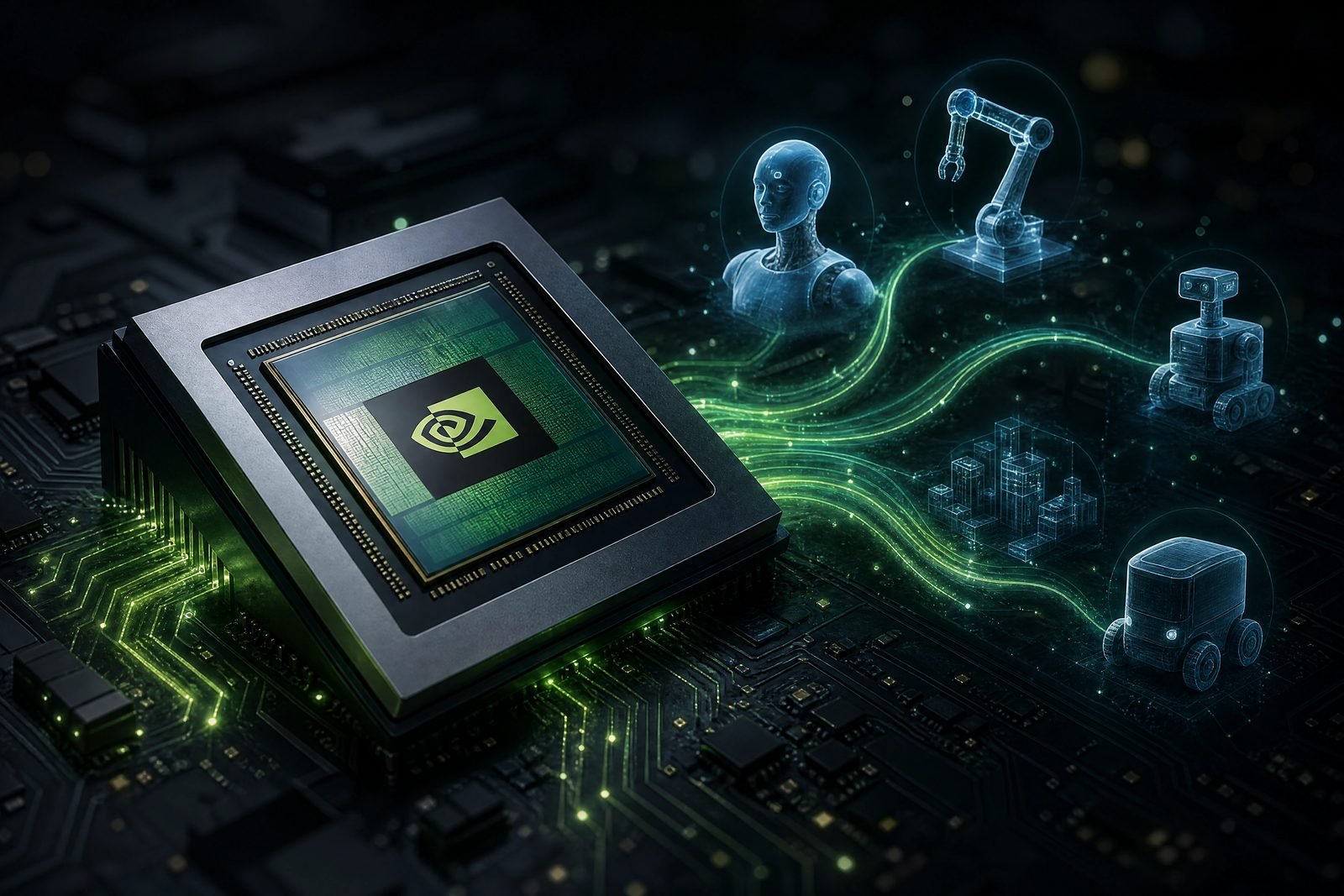
NVIDIA took two steps with Vera in the same week: it explained in detail how its first CPU built for AI agents is put together, and it named the first large customer that will run it. The architecture was laid out at Hot Chips 2026, held at Stanford from 23 to 25 August, and on the 24th the company announced that SpaceXAI will deploy Vera for the infrastructure behind Grok.
What makes a CPU for agents different
The starting point is that an AI agent does more than produce answers: it runs code, calls tools, processes data and chains steps between one model call and the next. None of that intermediate work happens on the GPU, it happens on the CPU. When that part stalls, the GPU sits waiting.
Vera is designed around that bottleneck. It carries 88 in-house Olympus cores on Arm architecture, a technique NVIDIA calls spatial multithreading to spread work across them, and LPDDR5X memory delivering up to 1.2 TB/s of bandwidth. That is a clear step up from Grace, the company’s previous CPU, which relied on a slower memory interface.
The numbers, and where they come from
NVIDIA states that Vera completes tasks up to 1.8 times faster than an x86 CPU across agentic AI, reinforcement learning and data processing workloads. That figure deserves to be read for what it is: a measurement by the company itself, using its own tests.
The only independent comparison published so far puts Vera ahead of AMD’s EPYC 9655P compiling the Linux kernel. It is a data point from outside the manufacturer, which is more than an architecture presentation usually offers, but it is also a workload with nothing to do with AI agents. The real test will come from independent measurements on agent workloads in deployed systems.
SpaceXAI, from the data centre to orbit
SpaceXAI will use Vera to accelerate orchestration and data processing around Grok while expanding its infrastructure on the Vera Rubin platform, heading towards gigawatts of computing capacity.
The striking part of the announcement is the other one: the company plans to take that same architecture into space. Its first Starmind satellite will be based on an adapted Vera Rubin NVL72 system, an environment where power, thermal management and reliability impose conditions that look nothing like a conventional data centre.
“Agentic AI requires a new kind of computing system — one built not only to generate answers, but to take action,” said Ian Buck, vice president of hyperscale and high-performance computing at NVIDIA, when the agreement was presented.
Why NVIDIA builds its own CPU
Vera is not NVIDIA’s first central processor. Grace, its first Arm server CPU, began shipping in 2023 as one half of the Grace Hopper and Grace Blackwell pairings. What is new here is how much microarchitecture detail the company has made public, something it rarely shares, and the role it gives Vera inside Vera Rubin NVL72, the rack-scale system that succeeds the Blackwell and GB200 platform.
The underlying motive is control. Designing the CPU rather than pairing its GPUs with silicon from Intel or AMD lets NVIDIA tune the interconnect between the two chips and reduces how much its server economics depend on another vendor’s roadmap and pricing. It is exactly what Google has been doing with Axion, Amazon with Graviton and Microsoft with Cobalt, with one difference: in NVIDIA’s case the investment reinforces a platform it already controls end to end, rather than reducing its dependence on one.
When it arrives
The Vera Rubin platform entered full-scale production at the end of May. NVIDIA has published neither pricing nor a specific general availability date for Vera, and its own press material notes that much of what is described is offered on a when-and-if-available basis. With the SpaceXAI deployment announced and the architecture now on the table, what remains to be seen is how it behaves outside the manufacturer’s own tests.