
 English
  Español
  Deutsch
  Français
  Português
  Italiano
  Nederlands
  Polski
  Svenska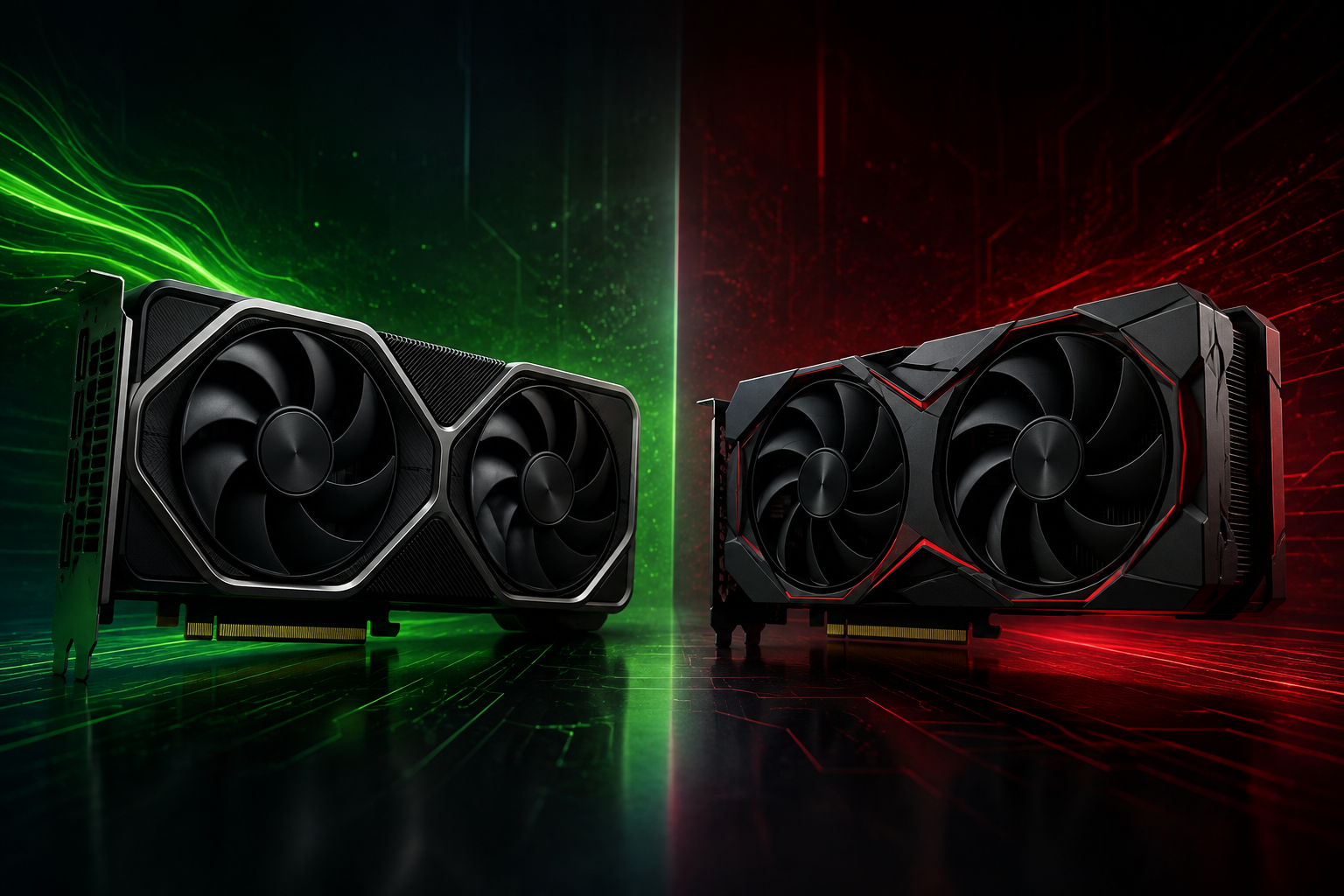
If you’re looking to upgrade your mid-range graphics card without spending a fortune, the battle between the Nvidia GeForce RTX 5060 and the AMD Radeon RX 9060 XT is the definitive value-for-money showdown right now.
Quick verdict: which one should you buy?
Buy the Nvidia GeForce RTX 5060 if: you mainly play competitive titles at 1080p, you want the lowest possible power draw (~145 W), you stream often (NVENC AV1), and you want to make the most of the DLSS 4 ecosystem with Multi-Frame Generation and ray tracing.
Buy the AMD Radeon RX 9060 XT (16 GB) if: you want more raw native performance, you play at 1440p (2K) or plan to move up soon, and you want a GPU that stays smooth for years thanks to its 16 GB of VRAM.
Technical specifications and key differences
| Feature | Nvidia GeForce RTX 5060 | AMD Radeon RX 9060 XT (16 GB) |
|---|---|---|
| Architecture | Blackwell (TSMC 4N) | RDNA 4 (TSMC 4nm) |
| Cores / Shaders | 3,840 CUDA Cores | 2,048 Stream Processors |
| VRAM | 8 GB GDDR7 | 16 GB GDDR6 |
| Memory bus | 128-bit | 128-bit |
| Bandwidth | ~448 GB/s | ~322 GB/s |
| PCIe interface | PCIe 5.0 x8 | PCIe 5.0 x16 |
| Power (TDP) | 145 W | 160 W |
| Video outputs | 1x HDMI 2.1b, 3x DisplayPort 2.1b | 1x HDMI 2.1b, 2x DisplayPort 2.1a |
| Power connector | 1x 8-pin (or 16-pin on OC models) | 1x 8-pin |
| AI upscaling | DLSS 4 (Multi Frame Generation) | FSR 4 (ML Upscaling) |
In-game performance: 1080p and 1440p benchmarks
Tests run at Ultra / max quality settings, paired with a Ryzen 7 7800X3D and 32 GB of DDR5 RAM.
| Game (Ultra) | Resolution | RTX 5060 (8 GB) | RX 9060 XT (16 GB) | Winner |
|---|---|---|---|---|
| Cyberpunk 2077 (pure raster) | 1080p | 84 FPS | 93 FPS | +10% AMD |
| Cyberpunk 2077 (raster) | 1440p | 52 FPS | 62 FPS | +19% AMD |
| Cyberpunk 2077 (Ray Tracing + DLSS/FSR Quality) | 1080p | 78 FPS | 69 FPS | +13% Nvidia |
| Call of Duty: Warzone | 1080p | 138 FPS | 156 FPS | +13% AMD |
| Call of Duty: Warzone | 1440p | 94 FPS | 112 FPS | +19% AMD |
| Black Myth: Wukong (High) | 1080p | 72 FPS | 76 FPS | +5% AMD |
| Black Myth: Wukong | 1440p | 44 FPS | 51 FPS | +15% AMD |
| Hogwarts Legacy (no RT) | 1080p | 91 FPS | 104 FPS | +14% AMD |
| Hogwarts Legacy | 1440p | 58 FPS | 73 FPS* | +25% AMD |
| Fortnite (UE5, Nanite/DX12) | 1080p | 96 FPS | 90 FPS | +6% Nvidia |
| Alan Wake 2 (Medium RT) | 1080p | 54 FPS | 46 FPS | +17% Nvidia |
*In Hogwarts Legacy at 1440p, the RTX 5060 is held back by its 8 GB of VRAM.
Deep dive: what this means in practice
The VRAM factor: 8 GB (Nvidia) vs 16 GB (AMD)
The RTX 5060 uses very fast GDDR7 memory, but its 8 GB starts to show its limits at 1440p when loading heavy texture packs, causing occasional frame drops in demanding games like Hogwarts Legacy. The RX 9060 XT, with 16 GB of GDDR6, gives you a lot more headroom: if you play at 1440p or want a card that will last several years without upgrading, AMD removes memory bottlenecks entirely.
Upscaling and Ray Tracing: DLSS 4 vs FSR 4
Nvidia still leads on image quality thanks to its dedicated AI hardware and DLSS 4 Multi-Frame Generation, delivering noticeably smoother motion without visible artifacts. AMD has closed the gap with FSR 4, based on machine learning running on RDNA 4’s Matrix Cores, offering a much sharper image reconstruction than previous generations.
Connectivity, power and compatibility
The RTX 5060 runs at PCIe 5.0 x8: on older motherboards limited to PCIe 3.0 you may notice a small residual performance loss (1-3%). The RX 9060 XT uses a full PCIe 5.0 x16 connection, with all the bandwidth available on any motherboard. A 500-550 W PSU is enough for the RTX 5060; 550-600 W is recommended for the RX 9060 XT. Both include DisplayPort 2.1 and HDMI 2.1b outputs, fully compatible with 240/360 Hz monitors and 4K displays.
Pros and cons

MSI GeForce RTX 5060 8G Ventus 2X OC
Pros
- Lower power draw and very cool temperatures (~145 W)
- Better performance in Ray Tracing and path-traced titles
- DLSS 4 ecosystem (Multi Frame Generation) and NVENC for streaming
- Fast GDDR7 memory
Cons
- 8 GB of VRAM is tight for 1440p in modern games
- PCIe bus cut down to x8

ASUS Dual Radeon RX 9060 XT 16 GB
Pros
- 16 GB of VRAM for long-term texture-heavy games
- Higher native FPS in rasterisation (1080p and 1440p)
- Full PCIe 5.0 x16 connection
- Better price-to-performance at 2K
Cons
- Weaker performance in heavy Ray Tracing versus Nvidia
- Slightly higher power draw (~160 W)
Conclusion and buying recommendation
| Your profile | Recommended pick |
|---|---|
| You play at 1080p, stream often, and want maximum efficiency | Nvidia GeForce RTX 5060 |
| You play at 1440p (2K) and want maximum longevity | AMD Radeon RX 9060 XT (16 GB) |